Picture this: you’re paddling mile 14 of a gorgeous 20-mile stretch down the Mohican River. The afternoon sun is hammering the back of your neck, the scenery is breathtaking — towering hemlocks, sandstone cliffs, a great blue heron lifting off from a gravel bar ahead of you. Life is perfect. Except for one small problem: your last water bottle is almost empty, and camp is still six miles downstream.
Every experienced paddler knows the rule of thumb — pack roughly one gallon of water per person per day. On a short afternoon float, that’s easy enough. But on a multi-day canoe-camping trip, carrying all the water you need quickly becomes impossible. A two-person, three-day expedition would require about six gallons — that’s nearly 50 pounds of water before you’ve packed a single piece of gear. Sooner or later, the river flowing right beneath your hull starts to look awfully tempting.
Here’s the problem: even water that looks pristine can harbor invisible threats. Bacteria like E. coli and Salmonella, protozoan parasites like Giardia and Cryptosporidium, and viruses like Norovirus can all be present in river water without changing its appearance, taste, or smell.
The good news? Science — specifically chemistry — gives us multiple reliable ways to turn that river water into safe drinking water. And you don’t need a chemistry degree to understand how they work. In this article, we’ll break down the molecular-level science behind each major purification method so you can make smart decisions on the water. If any of the chemistry concepts spark your curiosity (or if you’re a student who wants to dive deeper into the reactions we’ll discuss), a tool like Chemistry AI Helper can walk you through the equations and mechanisms step by step.
Let’s get into it.
What’s Actually Lurking in River Water?
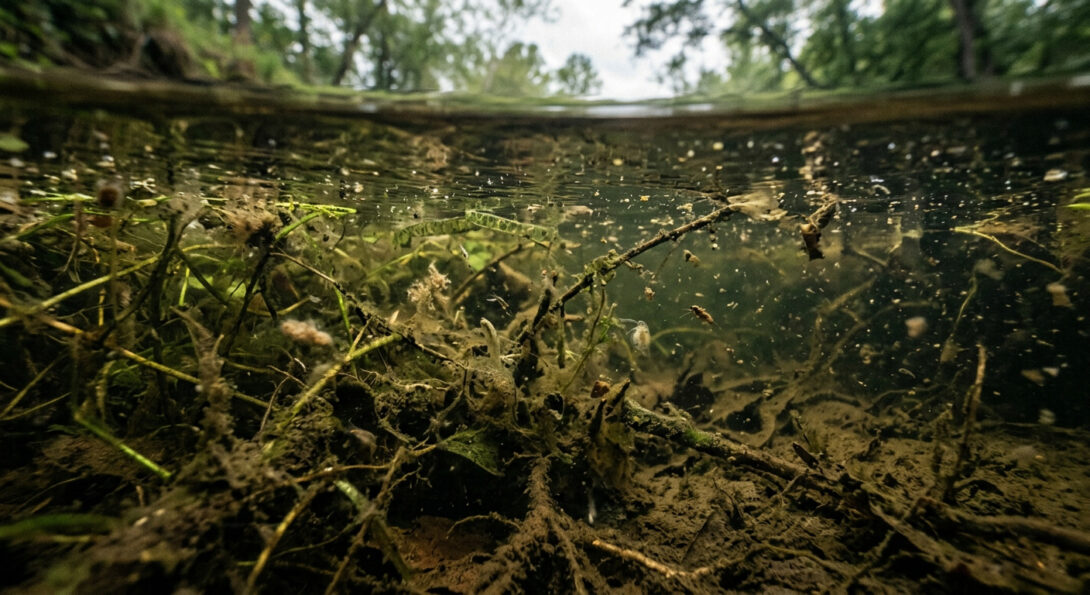
Before we talk about solutions, let’s understand the problem. Waterborne threats fall into three major categories, and they differ dramatically in size — which matters a lot when we get to filtration.
| Threat Type | Common Examples | Approximate Size | Notable Characteristics |
| Protozoa | Giardia lamblia, Cryptosporidium parvum | 5–15 µm | Form tough protective cysts; resistant to many chemical treatments |
| Bacteria | E. coli, Salmonella, Campylobacter | 0.2–5 µm | Generally susceptible to all purification methods |
| Viruses | Norovirus, Hepatitis A, Rotavirus | 0.02–0.1 µm | Extremely small; pass through most mechanical filters |
To put those sizes in perspective, a human hair is about 70 µm wide. Giardia cysts are roughly one-fifth the width of a hair. Viruses are roughly one-thousandth. You will never see them, smell them, or taste them.
Rivers that flow through agricultural regions — and the Mohican Valley in Ohio is surrounded by farmland — may also carry chemical contaminants like nitrates (NO3− ) and phosphates (PO43− ) from fertilizer runoff, as well as trace pesticides and herbicides. These won’t make you sick from a single drink the way Giardia will, but they’re worth knowing about because not every purification method removes them.
The bottom line: clear water is not the same as clean water. Now let’s look at what actually makes it safe.
Method #1 — Boiling: The Oldest Chemistry in the Book
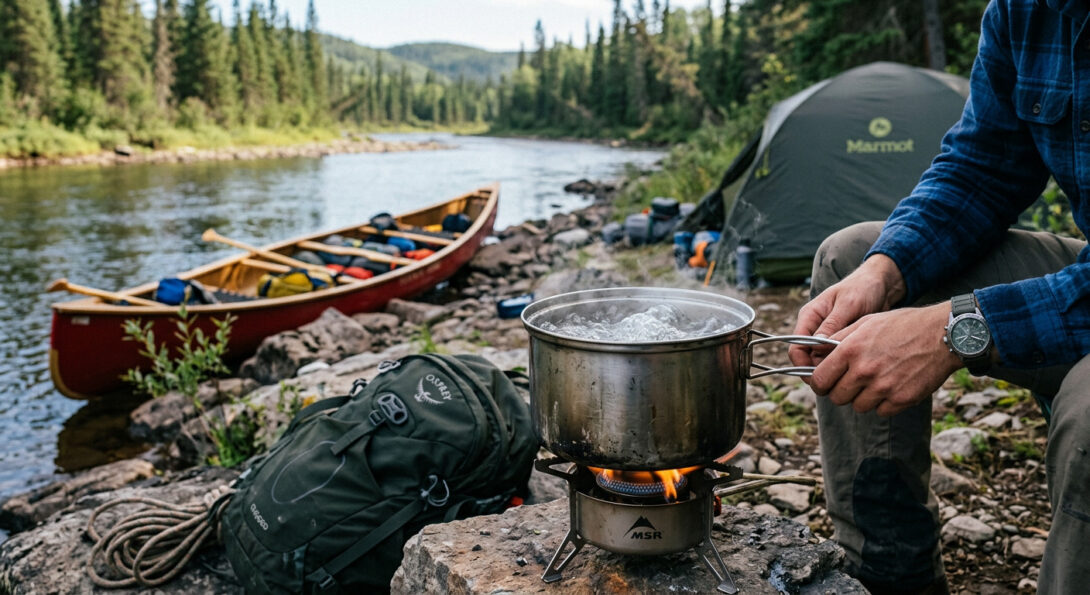
If humans have been doing something for thousands of years, it’s probably because it works. Boiling is the most ancient, most reliable, and most universally accessible method of water purification.
The Chemistry: Protein Denaturation
Every living pathogen relies on proteins to function — enzymes that drive metabolism, structural proteins that hold cells together, transport proteins that move molecules around. These proteins only work because they’re folded into precise three-dimensional shapes, held in place by a delicate web of:
- Hydrogen bonds between polar side chains
- Hydrophobic interactions between nonpolar regions
- Disulfide bridges (–S–S–) between cysteine residues
- Ionic (electrostatic) interactions between charged groups
When you heat water to 100°C, you dramatically increase the kinetic energy of every molecule in the system. That energy overwhelms the weak forces holding proteins in shape. Hydrogen bonds break. Hydrophobic cores are disrupted. The protein unfolds — a process called denaturation. Once an enzyme is denatured, it can no longer catalyze the reactions the organism needs to survive. The pathogen dies.
This is the same chemistry that turns a translucent, runny egg white into a firm, opaque solid when you cook it. The proteins in the egg (primarily ovalbumin) unfold and tangle together irreversibly. The same thing happens to the proteins inside Giardia, E. coli, and Norovirus when you boil water.
Practical Advice for Canoeists
- Bring water to a full rolling boil for at least 1 minute. The Mohican River valley sits at roughly 300 meters (about 1,000 feet) above sea level, so the standard 1-minute boil is sufficient. If you’re ever paddling at higher elevations — above 2,000 m (6,500 ft) — the CDC recommends boiling for 3 minutes, because water boils at a lower temperature at altitude and the reduced heat requires extra time.
- Use a lightweight backpacking stove and a metal pot. Many canoe campers already carry one for preparing meals — double duty.
- Let the water cool naturally in a clean, covered container. Don’t pour it back into a dirty bottle.
Pros and Cons
| ✅ Pros | ❌ Cons |
| Kills all pathogen types — bacteria, viruses, and protozoa | Requires fuel (canister weight, pack space) |
| No special equipment beyond a pot and heat source | Time-consuming: boiling + cooling can take 30+ minutes |
| No chemical aftertaste | Does not remove sediment, chemical contaminants, or microplastics |
| Universally understood — no instructions to misread | Impractical as a trailside/on-water solution |
Best use on a canoe trip: Purifying water at camp for cooking and preparing hot drinks. Since you’re already firing up the stove for dinner, boiling your drinking water for the next morning costs you almost nothing extra.
Method #2 — Chemical Purification: Chlorine Dioxide and Iodine
Chemical treatments are the ultralight paddler’s best friend. A tiny bottle of drops or a few foil-wrapped tablets weigh next to nothing, take up almost no space in a dry bag, and can purify liters of water with no moving parts to break.
Chlorine Dioxide (ClO2 ): How It Works
Chlorine dioxide is a powerful oxidizing agent, meaning it’s exceptionally good at stealing electrons from other molecules. When ClO2 molecules encounter a pathogen, they attack the organic molecules in its cell membrane and internal enzymes, ripping electrons away and destabilizing critical structures.
This is redox chemistry in action — one of the most fundamental concepts in all of chemistry:
- Oxidation: The pathogen’s biomolecules lose electrons. Their molecular structures collapse.
- Reduction: ClO2 gains electrons and is converted to the much less reactive chlorite ion:
ClO2 +e−→ClO2−
In practice, ClO2 tears through the lipid bilayers of bacterial cell membranes, disrupts the capsid proteins of viruses, and — given enough contact time — even penetrates the notoriously tough cyst walls of Cryptosporidium. That last point matters: Crypto cysts are famously resistant to regular chlorine (the stuff in tap water), but chlorine dioxide is a different molecule with different oxidation chemistry, and it can handle them — provided you wait long enough.
Popular products:
- Aquamira Water Treatment Drops — a two-part system where you mix Part A (chlorine dioxide) and Part B (phosphoric acid activator) and wait 5 minutes before adding to water. Treatment time: 15–30 minutes for bacteria and viruses; up to 4 hours for Cryptosporidium.
- Katadyn Micropur MP1 Tablets — single-tablet system; 30 minutes for bacteria and viruses, 4 hours for Crypto.
Iodine: The Older Alternative
Iodine (I2 ) works through a similar oxidative mechanism. Molecular iodine penetrates cell walls and disrupts internal metabolic processes by oxidizing essential biomolecules. However, iodine has some notable drawbacks:
- It leaves a strong medicinal taste that many people find unpleasant.
- It is less effective against Cryptosporidium cysts even with extended contact time.
- It is not recommended for long-term use — prolonged iodine consumption can interfere with thyroid function, and it should be avoided by pregnant women and people with thyroid conditions.
- Vitamin C tablets can neutralize the taste after the treatment time is complete, but that’s one more thing to pack.
For these reasons, most experienced paddlers have shifted to chlorine dioxide as the chemical treatment of choice.
Practical Advice for Canoeists
- Chemical treatments are ideal as a backup method. Toss a few Micropur tablets into your first-aid kit — they weigh virtually nothing and could save your trip if your filter breaks or you lose gear in a capsize.
- In cold water (below 5°C), chemical reactions slow down. Double the treatment time.
- In very turbid (cloudy) water, particles can shield pathogens from chemical contact. Pre-filter through a bandana or coffee filter first.
- After treatment, remove the cap from your water bottle and let treated water run over the threads — the rim of your bottle is a contamination point people often forget.
Pros and Cons
| ✅ Pros | ❌ Cons |
| Ultralight and incredibly compact | Wait time: 30 minutes to 4 hours |
| Kills bacteria, viruses, and protozoa (ClO2 ) | Can alter taste (iodine especially) |
| Inexpensive (~$0.50–1.00 per liter) | Less effective in cold or turbid water without adjustments |
| No moving parts — nothing to break | Does not remove sediment, chemicals, or microplastics |
Method #3 — Mechanical Filtration and Activated Carbon: Chemistry You Can Squeeze
If chemical tablets are the backup plan, a good portable filter is the daily workhorse of water purification on a canoe trip. Modern filters are fast, lightweight, and require nothing but your own grip strength.
Hollow-Fiber Membrane Filtration
The most popular backcountry filters today — the Sawyer Squeeze, Katadyn BeFree, and Platypus QuickDraw — use hollow-fiber membrane technology. Inside the filter cartridge are hundreds of tiny U-shaped tubes made from a polymer membrane riddled with microscopic pores, typically 0.1 to 0.2 µm in diameter.
The principle is beautifully simple: physical size exclusion. Any particle larger than the pore diameter cannot get through.
- Protozoa (Giardia at 5–15 µm, Cryptosporidium at 4–6 µm): Blocked easily. They’re 25–150× larger than the pores.
- Bacteria (E. coli at ~0.5 × 2 µm, Salmonella at ~0.7 × 2.5 µm): Blocked. Even the smallest bacteria are at or above the pore size.
- Viruses (Norovirus at ~0.027 µm, Hepatitis A at ~0.03 µm): Not blocked. Viruses are 3–7× smaller than the pores and pass right through.
This is the critical limitation of mechanical filters. For most paddling destinations in North America — including the Mohican River — virus contamination of surface water is relatively uncommon (viruses in water are more associated with human sewage, and are a bigger concern in developing countries). But if you’re paddling downstream of a sewage treatment plant or in a region with known viral contamination, a filter alone is not enough.
Activated Carbon: The Chemistry of Adsorption
Many of these filters include a secondary stage of activated carbon, and the chemistry here is fascinating.
Activated carbon is typically made from coconut shells, wood, or coal that has been treated (or “activated”) with high-temperature steam or chemical processes to create an astronomical number of microscopic pores. The result: a single gram of activated carbon can have a surface area of 1,000 to 3,000 m2 — meaning a teaspoon of the stuff has more surface area than an entire football field.
Why does surface area matter? Because activated carbon works through adsorption — a process where contaminant molecules bind to the carbon surface. (Note: this is adsorption, not absorption. The molecules stick to the surface rather than being soaked into the material.)
The binding forces at work are:
- Van der Waals forces — weak, short-range attractive forces between all molecules caused by transient fluctuations in electron distribution (temporary or induced dipoles). Individually weak, they become collectively powerful across the enormous surface area of activated carbon.
- Induced dipole interactions — the electron clouds of nonpolar contaminant molecules are distorted by proximity to the carbon surface, creating a temporary attraction.
These forces are particularly effective at capturing:
- Chlorine and chloramine residues
- Taste and odor compounds (the earthy “river” taste)
- Many organic contaminants — including some pesticides, herbicides, and volatile organic compounds (VOCs)
However, activated carbon does not kill pathogens. It works alongside the hollow-fiber membrane: the membrane handles the biology, the carbon handles the chemistry.
Practical Advice for Canoeists
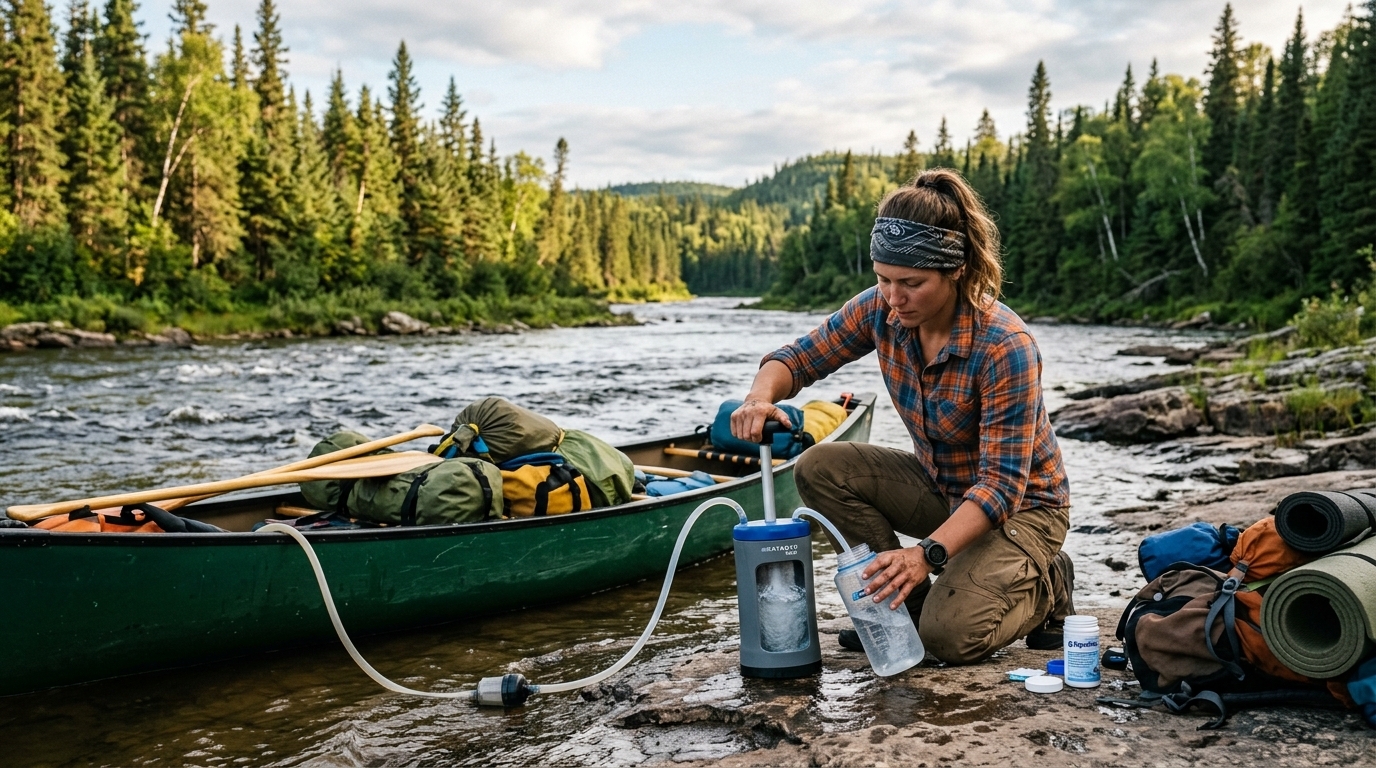
- A squeeze filter is the fastest, most convenient daily-use purification method. Fill a dirty water bag from the river, screw on the filter, squeeze clean water into your bottle. The entire process takes about 30 seconds per liter.
- Never let your filter freeze. Ice crystals expand inside the hollow fibers, creating micro-cracks that are invisible to the eye but large enough for pathogens to sneak through. On cold-weather trips, sleep with your filter inside your sleeping bag.
- In silty or sediment-heavy water, pre-filter through a bandana, coffee filter, or even a clean t-shirt to catch the largest particles. This prevents premature clogging and dramatically extends the life of your filter cartridge.
- Most hollow-fiber filters can be backflushed — reverse the water flow to push clogged particles back out. Carry the backflush syringe; it takes 10 seconds and restores flow rate.
Pros and Cons
| ✅ Pros | ❌ Cons |
| Instant clean water — drink as you filter | Does not remove viruses |
| No chemical taste; carbon actually improves taste | Can clog in silty or algae-rich water |
| Lightweight squeeze models weigh only 2–3 oz | Filter cartridge has a finite lifespan (typically 1,000–4,000 L) |
| Removes sediment, protozoa, bacteria, and some chemical contaminants | Can be destroyed by freezing |
Method #4 — UV Light Purification: Scrambling DNA with Photons
Ultraviolet purification takes a completely different approach from everything we’ve discussed so far. Instead of physically blocking pathogens, denaturing their proteins, or oxidizing their membranes, UV treatment attacks the most fundamental molecule of life: DNA.
The Chemistry: Thymine Dimerization
Portable UV purifiers like the SteriPEN and CrazyCap emit UV-C radiation at a wavelength of approximately 254 nm — deep in the ultraviolet spectrum, well beyond what our eyes can see or the sun delivers at Earth’s surface (the ozone layer absorbs most UV-C from sunlight).
When UV-C photons strike a microorganism, they are absorbed by the nucleobases of its DNA, particularly thymine. The absorbed energy causes a photochemical reaction: two adjacent thymine bases on the same DNA strand form abnormal covalent bonds with each other, creating a structure called a cyclobutane pyrimidine dimer (CPD):
T+Thν(254nm) T⟨⟩T
In this notation, hν represents the energy of a UV-C photon (h is Planck’s constant, ν is the photon’s frequency). The resulting thymine dimer creates a “kink” in the DNA strand that blocks the molecular machinery responsible for DNA replication. If the organism can’t copy its DNA, it can’t reproduce — and a pathogen that can’t reproduce in your gut can’t make you sick.
The beauty of this method is its universality. Every organism on Earth — bacteria, viruses, and protozoa alike — relies on nucleic acids (DNA or RNA). UV-C doesn’t care about cell wall thickness, cyst armor, or membrane chemistry. If the photon reaches the nucleic acid, the damage is done.
Practical Advice for Canoeists
- Treatment is fast — most UV devices purify 1 liter in 60–90 seconds. You can treat water right at the river’s edge and drink immediately.
- UV purifiers require power — either disposable batteries or USB-rechargeable cells. On a multi-day trip, bring backup batteries or a small solar panel.
- Turbidity is the enemy of UV purification. Suspended particles in murky water create shadows that shield pathogens from the UV light. If the river is muddy, you must pre-filter (even through a bandana) before using a UV device. As a general rule, if you can’t see through the water in your bottle, UV treatment alone is not reliable.
- UV treatment provides no residual protection. The water is safe the moment it’s treated, but it doesn’t remain “guarded” the way chemically treated water does. Treat and drink promptly; don’t store treated water for extended periods without retreating.
Pros and Cons
| ✅ Pros | ❌ Cons |
| Kills bacteria, viruses, and protozoa | Requires battery power |
| Very fast (~60–90 seconds per liter) | Ineffective in cloudy or silty water without pre-filtration |
| No chemical taste whatsoever | Does not remove sediment, chemical contaminants, or particulates |
| Compact and lightweight | No residual disinfection — treat and drink right away |
Choosing the Right Method for Your Trip
There is no single “best” purification method — only the best method for your specific trip. Here’s a practical decision guide tailored to paddling scenarios:
| Trip Type | Primary Method | Backup Method | Why This Combo? |
| Half-day float (5–10 mi) on the Mohican | Bring all water from home | Squeeze filter in dry bag | Short enough to carry what you need; filter is insurance for emergencies |
| Full-day trip (10–20 mi) | Squeeze filter with activated carbon | ClO2 tablets | Filter provides instant water all day; tablets cover you if the filter clogs or is lost in a tip-over |
| Multi-day canoe camping (2–4 days) | Squeeze filter (daily use) + boiling at camp | ClO2 tablets | Filter handles on-the-water needs; boiling at camp gives you hot water for meals and a backup purification method; tablets are the emergency last resort |
| Remote or international river expedition | UV purifier + squeeze filter | ClO2 tablets | UV covers the virus threat that filters miss; filter handles sediment and protects the UV device from turbidity; tablets are the never-fail backup |
The Golden Rule: Always Carry Two Methods
Gear breaks. Batteries die. You lose a dry bag in a rapid. Murphy’s Law is undefeated on the river. If your only purification method fails on day two of a three-day trip, you have a genuine survival problem.
The lightest, simplest insurance policy: toss a few chlorine dioxide tablets into your first-aid kit. They weigh a few grams, cost a few dollars, and they work. Even if you never open the foil, knowing they’re there buys you peace of mind worth far more than their weight.
Quick-Reference Chemistry Cheat Sheet
For the visual learners (and for anyone who wants to screenshot something handy for their next trip), here’s the entire article compressed into one table:
| Method | Key Chemistry | Bacteria | Viruses | Protozoa | Removes Chemicals? | Speed | Weight/Bulk |
| Boiling | Protein denaturation (heat disrupts H-bonds, hydrophobic interactions) | ✅ | ✅ | ✅ | ❌ | Slow (boil + cool) | Stove + pot |
| ClO2 Tablets | Redox — electron transfer oxidizes cell membranes | ✅ | ✅ | ✅ (4 hr wait) | ❌ | 30 min – 4 hr | Ultralight |
| Iodine | Oxidation of internal metabolic molecules | ✅ | ✅ | ⚠️ Weak vs. Crypto | ❌ | 30 min | Ultralight |
| Hollow-fiber filter | Physical size exclusion (0.1–0.2 µm pores) | ✅ | ❌ | ✅ | ⚠️ Partial | Instant | 2–3 oz |
| Activated carbon | Adsorption via Van der Waals forces | ❌ | ❌ | ❌ | ✅ | Instant | Built into filter |
| UV-C light | Thymine dimerization — blocks DNA replication | ✅ | ✅ | ✅ | ❌ | ~90 sec/L | Small + batteries |
Paddle Smart, Drink Safe
There’s something deeply satisfying about understanding why something works, not just that it works. The next time you drop a chlorine dioxide tablet into a bottle of river water, you’ll know that you’re watching a redox reaction — an electron transfer — dismantle pathogens at the molecular level. When you squeeze water through a filter, you’ll picture those hollow-fiber membranes with their 0.1-micron pores physically blocking bacteria thousands of times smaller than a grain of sand. And when you boil water over your camp stove, you’ll know you’re unraveling the proteins that every living pathogen depends on.
That knowledge doesn’t just make you a more interesting campfire companion. It makes you a safer, more confident paddler — someone who can adapt when conditions change, troubleshoot when gear fails, and make smart decisions when it matters.
A multi-day canoe trip is one of the best ways to disconnect from screens and reconnect with the natural world. But respecting the water you paddle on means understanding what’s in it — and knowing how to make it safe.
Ready to plan your next adventure? Check out our Mohican River trip options — from easy half-day floats to full multi-day expeditions — and hit the water with confidence, a good filter, and a backup plan.